(small).jpg)
Meet the Maker - Aimee Payton
At Aimee Alice Payton, you’ll find an eclectic mix of traditional soft and hard handmade lampshades, each inspired by Aimee’s keen eye for distinctive trims and fabrics - many of which she has collected on her travels.
Following a varied career in theatre design and working with historic Asian textiles, Aimee trained in upholstery and lampshade making, combining her creative vision with practical expertise. Today, she creates beautiful bespoke lampshade commissions from her extensive fabric collection, while also sharing her skills through her popular workshops.
We spoke to Aimee about her business, her love of fabrics and lampshade making, and how she brings the two together. Read on for the full story.

Hi there Aimee!
How are you today and what’s on your workbench?
I’m good thank you, a bit of a busy juggle as always but in a nice way. On my workbench at the moment I’ve got a real mix of lampshade commission pieces on the go. There is a delicate lace covered shade with fringing, an elegant white dupion shade, a huge scalloped shade in zingy orange silk and another small shade with four different clashing printed cottons and pink pompoms. I love the variety!
How do you start the design process for your lampshades and where does your inspiration come from?
It usually starts with the fabric. I love the process of pulling fabrics and trims together to see what feels right next to each other. But I also really enjoy trying to recreate a complex historic form that I’ve seen in a 1940s film or something like that.

How would you describe your style?
My taste is quite eclectic and I think that definitely shows in the work I make. I think this may be why I struggle to constrain my style. I used to work in the Eastern Art Department at the Ashmolean Museum so I am very drawn towards Asian textiles, but I’m equally fascinated by the history of textiles across the world. Having lots of different styles probably isn’t the easiest thing from a marketing point of view, but it makes sense for how I like to work and it does warm my soul.

If we delved into your fabric stash, what would we find?
A bit of everything really. Lots of Indian block prints, all different types of silk, linens, cottons, upholstery-weight fabrics, and random offcuts I cannot quite part with because I know they will be useful one day. I have a lot of textiles that I have picked up on my travels but I have also been the happy recipient of other people’s collections. It is not the most orderly stash, but I usually know where everything is, even if it does not look like it.
You’re an upholsterer, as well as a lampshade maker - which came first?
It was actually around the same time. I just had a go at things in my own home. They were fun, but didn’t last very long. I then studied upholstery professionally for 3 years and lampshade making helped support that.

When and why did you start making lampshades?
I started making lampshades after my brother bought me the book, Handmade Lampshades by Natalia Price-Cabrera. My time working at the museum was naturally winding down and I was finding my way back to making again. I’d previously trained in theatre design, mainly costume but also lighting, so I’d always had an interest in how things are made and what messages they subtly convey.
We noticed that you sell and take commissions for both hard and soft handstitched lampshades. How have you developed the skills to make both?
A lot of it has been self-taught through trial and error, however a fantastic weekend workshop with Angela Constantinou really set me up for stitched lampshades.
My upholstery training helped me think about how to reconstruct something with improvements or changes, rather than just replace exactly what was removed. I am very curious so I love taking on something that I am not quite sure how it is constructed. I’ve had to learn to be happy taking what I have done apart and starting all over again if it’s not quite worked.

What’s your favourite part of the lampshade making process?
The design stage is really exciting for me. And that can be the playing with fabric, or the working out how to construct something. But for some reason I also love the most fiddly annoying bits. It’s so satisfying when the fabric finally does exactly what you want it to do.
What’s the mix of shades you make to sell online versus lampshade commissions, as part of your business?
It is mostly commissions. But in the run up to Christmas it is sales at events and online

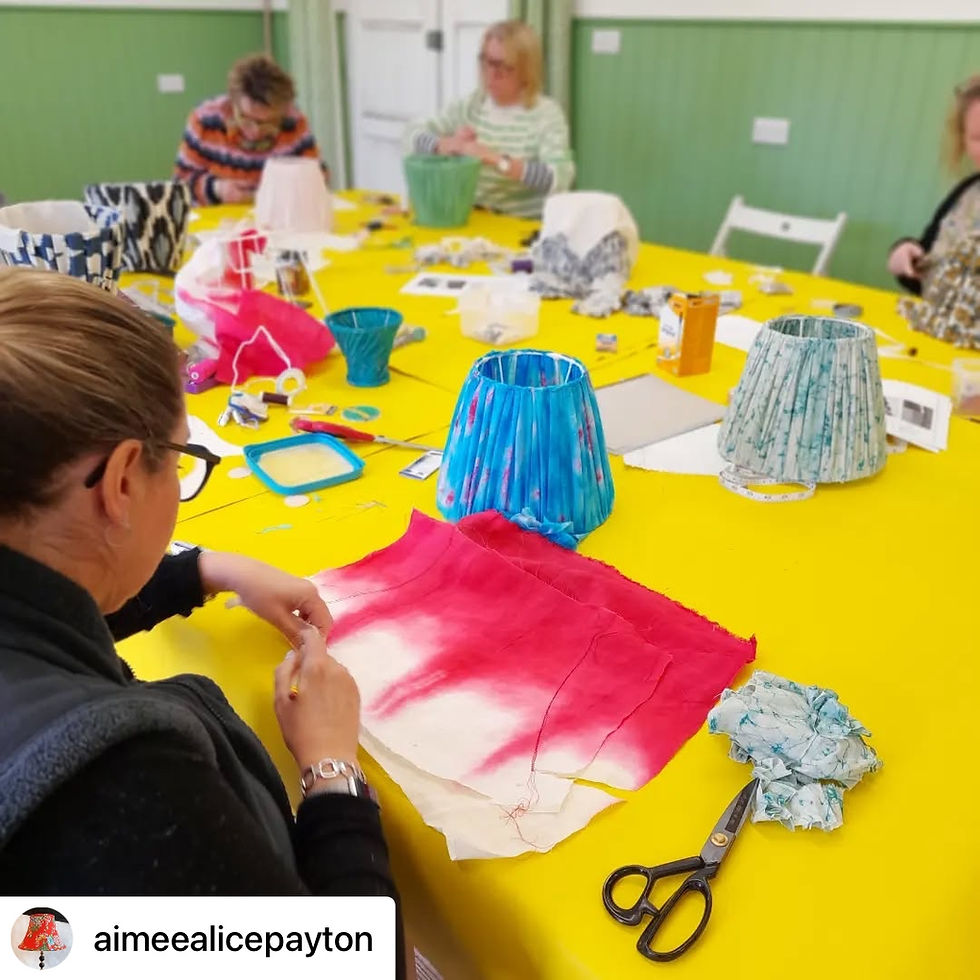
We can see you offer a range of lampshade making workshops. Can you tell us a bit more about the workshops you teach?
I teach a range of different styles, from modern rolled shades to hand stitched ones too. I also run a workshop called Designing with Light where I share some of insights from my theatre design training.
What does teaching workshop bring to your business?
I love teaching. Lampshades used to be made in the home, much like dress making. I am delighted to share my excitement about this with others.
As a regular stall holder at craft and design markets, what’s the benefits of being part of these events?
For me this is mostly about making contacts for commissions. I’ve found I need to be quite selective about which markets I do, and it really helps to be alongside makers whose work sits in a similar price range. I actually run two markets for this reason. One in Berkshire with Modern Makers Collective and the other in Wiltshire called The Makers Exchange.
If you could offer a piece of advice to new lampshade makers in business, what would it be?
Don’t rush the finishing stage. The details really matter. And don’t let anything out of the workshop that you’re not proud of.

How do you split your time between the different elements of your business i.e. upholstery, lampshade making, and teaching?
Every week is different. Upholstery tends to be more project based, so that will take bigger blocks of time. Lampshades are often fitted around that, and workshops are planned in advance so I can build everything else around them.

When are you at your most productive?
Late morning onwards, once I have properly started. I am not great first thing, I need a bit of time to get going. If I’m really stuck into a project I can easily work until 8 or 9, completely forgetting about dinner.
And your favourite sustenance when you’re working?
I want to say healthy food with a heavy dose of vegetables. However, if I’m in final panic mode running up to a hard deadline then chocolate!
Can we take a peek at your workspace, and can you tell us a little about it?
My workspace is practical rather than polished. It is set up for making, so there are always materials out, tools within reach, and creative chaos going on everywhere. It is not minimalist at all, and it works for how I like to work. When I tidy up, it never lasts very long.

Where would you like to be in 10 years time?
Still making, but with a slightly calmer rhythm, if that is actually possible, with a larger stash of fabric and more styles, shapes and designs to work with.
What have you learned that’s been invaluable to your creative process?
Just have a go. If it doesn’t work out, it’s only a lampshade. My house is full of shades that have beautiful fabrics but with the odd small flaw somewhere. I don’t mind that at all but I can’t sell something that’s not perfect. Obviously if it’s a client’s shade I’m recovering then careful planning is essential.
Any future plans for your business you would like to share?
I made a shade for a client a while ago that has simple embroidery stitches on it. I loved making this and plan to make a mini collection. However as always, my creative experiments are the last thing on the list unfortunately. Maybe I should give myself a deadline to do this for this year’s festive season.
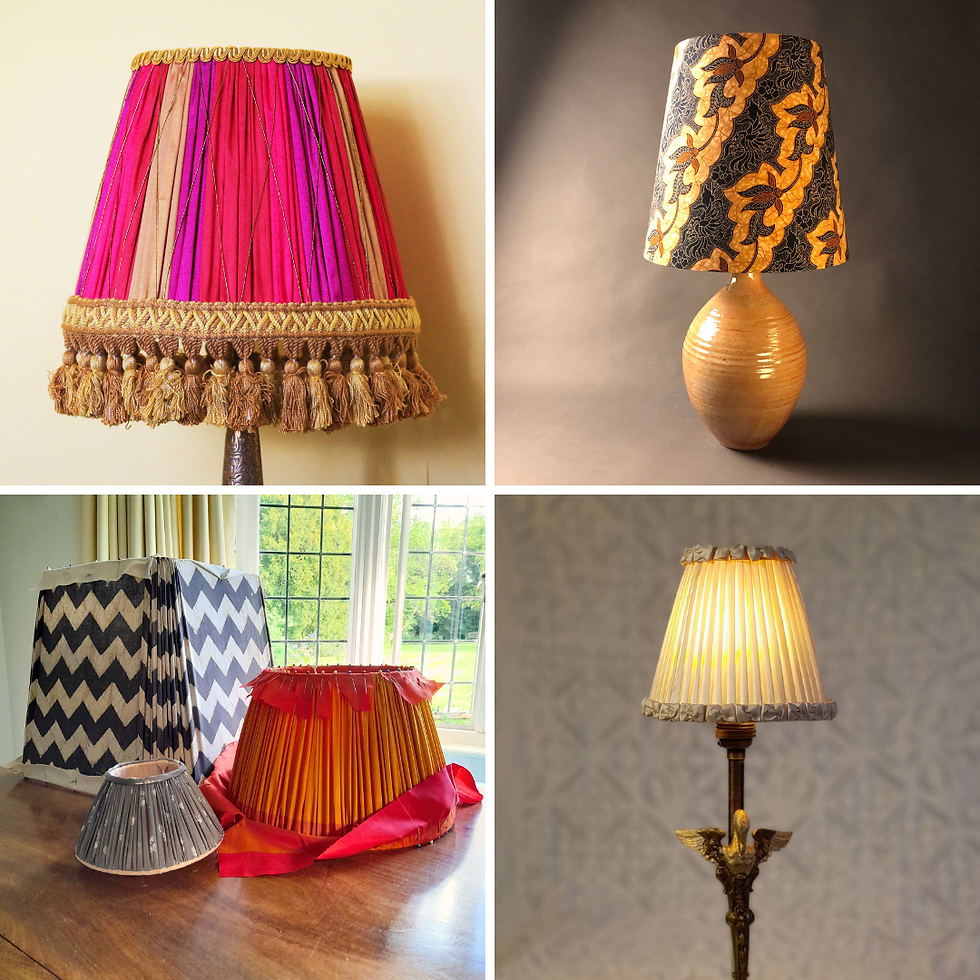

Browse Aimee's range of colourful and textiles led lampshades and pick from either handcrafted hard or traditional soft shapes at aimeealicepayton.co.uk. Why not give her a friendly follow on Instagram and Facebook too!
Instagram: @aimeealicepayton
Facebook: @aimeealicepayton
Website: www.aimeealicepayton.co.uk


Comments